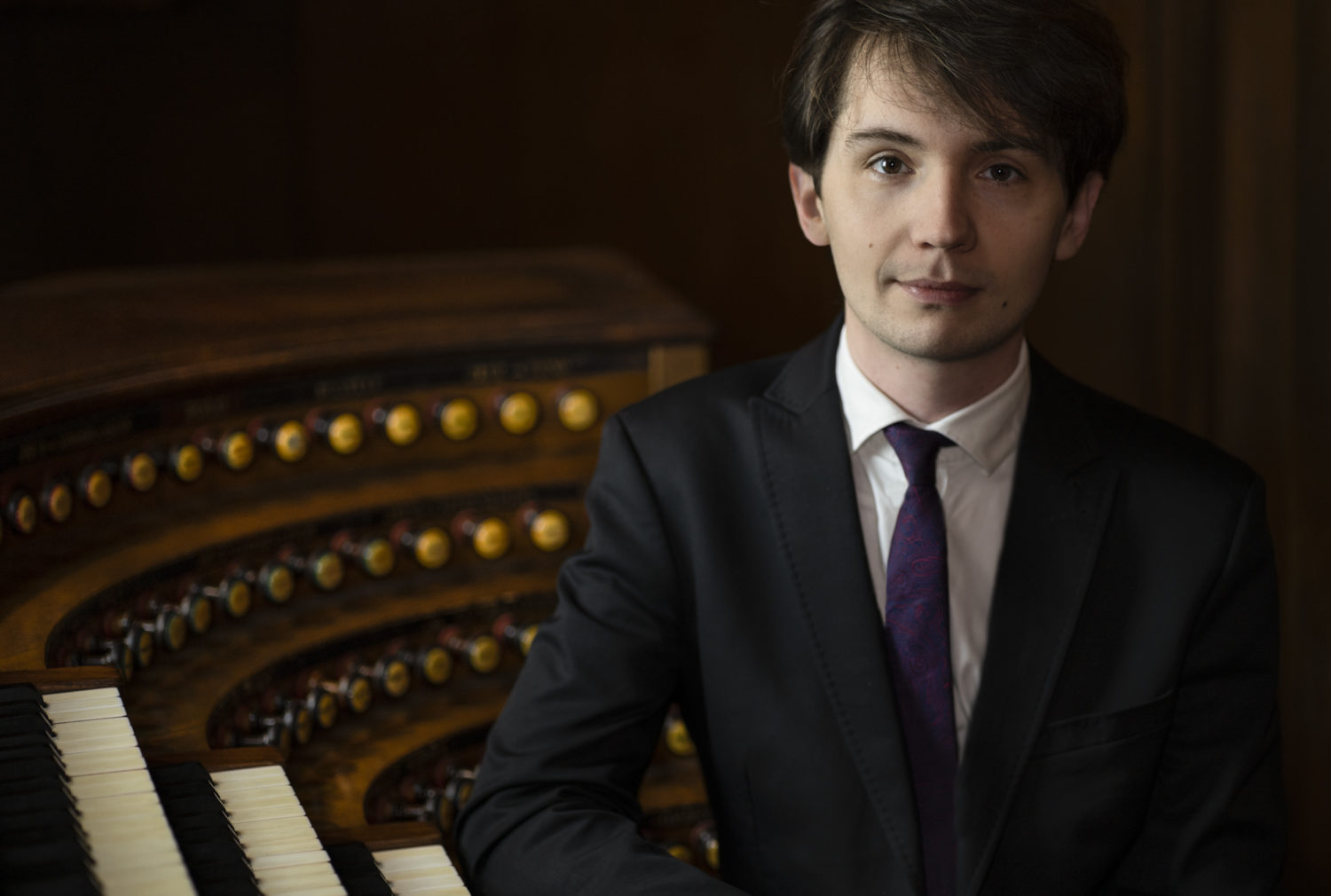
Karol Mossakowski is one of the leading organists of his generation. Renowned for both his interpretation and improvisation skills, he pursues an international career in both areas of practice as they mutually enrich one another. He is the winner of an important number of international first prizes, including Prague Spring Competition and the Grand Prix de Chartres. In 2023 he was appointed titular organist at Saint-Sulpice in Paris, as a successor to such musicians as Charles-Marie Widor, Marcel Dupré and Daniel Roth.
A few highlights of this upcoming season include debuts at Berlin Philharmonie, Berlin Konzerthaus, and Zürich Tonhalle. He will play recitals at the Prague Spring Festival and throughout a tour in Japan, at such venues as Izumi Hall in Osaka and Musashino Concert Hall in Tokyo.
Last season, Karol performed with the Warsaw Philharmonic Orchestra and Daniel Raskin, and the Polish National Radio Symphony and Pierre Bleuse ; he made a highly acclaimed debut recital at Hamburg Elbphilharmonie and went on a hailed recital tour in the USA. For this occasion, New York Classical Review wrote : « Karol Mossakowski’s New York debut (…) provided brilliant displays of colors and dynamics, as well as displaying his extraordinary creativity and imagination. »
In 2023, he played the world premiere of Unstern, organ concerto by Philippe Hersant, with the Orchestre National de Lyon and Antony Hermus. This same year, he was the first organist ever to receive an ICMA orchestra award.
Karol was recently artist in residence at NOSPR Katowice, and Radio France in Paris for three seasons. Karol is the guest of such venues as the Philharmonie de Paris, Auditorium de Radio France, MÜPA Budapest, Warsaw Philharmonie, NOSPR Katowice, NFM Wroclaw, Auditorium de Lyon, Auditorio Madrid, BOZAR Brussels, Palais Montcalm in Quebec, Konzerthalle Bamberg, Dresden Philharmonie, Paris, Berlin, Cologne, Vienna, Milan cathedrals. He performs with such orchestras as the Orchestre Philharmonique de Radio France, Orchestre National de France, NFM Wroclaw Philharmonic Orchestra, Orchestre national de Lyon, or the Odense Symphony Orchestra, under Myung-Whun Chung, Kent Nagano, Andris Poga, Jacek Kaspszyk, Antony Hermus, Mikko Franck, Fabien Gabel, Giancarlo Guerrero, Cristian Măcelaru or Lawrence Foster.
As a composer, this season he wrote Visages Célestes for mixed choir and two organs, premiered at Saint-Sulpice in 2025 with the ensemble Sequenza 9.3 and Catherine Simonpietri. Composer in residence at the Festival de musique sacrée de Saint-Malo from 2021 to 2023, he wrote several works in this context, including Les Voiles de la Lumière, oratorio for three organs and mixed choir, as well as Trois Versets for three organs.
Karol Mossakowski seeks to keep music alive thanks to improvisation, to which he gives an important role in his recitals and develops in silent films accompaniment. In 2017 his accompaniment of Dreyer’s Jeanne d’Arc for Lyon’s Festival Lumière was released in DVD on Gaumont.
In 2021 he released his first solo album, Rivages, featuring works from Bach, Mozart, Mendelssohn, and Liszt connected by improvisations. Two years later, he recorded Poulenc’s organ concerto and Jongen’s Symphonie Concertante with the NFM Wroclaw Philharmonic Orchestra and Giancarlo Guerrero, an album that was released in 2023 and critically acclaimed internationally by the media. In 2025, he released his first album on the organ of Saint-Sulpice, paying tribute to his predecessors.
In 2014-2015 Karol was Young Artist in Residence at St. Louis Cathedral, New Orleans. From 2017 to 2023 he was the titular organist of Lille’s Cathedral. Deeply committed to pedagogy, he was professor of improvisation at the Higher School of Music of the Basque Country (Musikene) from 2019 to 2026.
Karol Mossakowski started the piano and the organ at three years old with his father. After musical studies in Poland, he entered the organ, improvisation, and composition classes at the Paris Conservatory as a student of Olivier Latry, Michel Bouvard, Thierry Escaich, Philippe Lefebvre.
L’un des organistes les plus en vue de sa génération, Karol Mossakowski est reconnu tant pour ses qualités d’interprète que d’improvisateur, et mène une carrière internationale très active dans ces deux champs qu’il ne cesse de nourrir mutuellement. Il est lauréat d’un grand nombre de concours internationaux dont le Grand Prix de Chartres et le Printemps de Prague. En 2023 il est nommé organiste titulaire du prestigieux grand orgue Aristide Cavaillé-Coll de Saint-Sulpice à Paris, prenant la suite d’une lignée de musiciens notamment marquée par les figures de Charles-Marie Widor, Marcel Dupré et Daniel Roth.
Cette saison, Karol fait notamment ses débuts à la Philharmonie de Berlin, au Konzerthaus de Berlin, et à la Tonhalle de Zurich. Il est l’invité du Festival du Printemps de Prague, et part en tournée de récitals au Japon dans des salles comme l’Izumi Hall d’Osaka et le Musashino Concerthall de Tokyo. En 24/25, il fait ses débuts en récital à l’Elbphilharmonie de Hambourg, et part en tournée aux USA : « Le tout premier récital de Karol Mossakowski à New York (…) était à la fois empreint d’une dynamique et de couleurs exceptionnelles, et marqué par une incroyable créativité et imagination », écrit un critique de la New York Classical Review à cette occasion.
Il joue 2023 la création mondiale de Unstern, Concerto pour orgue de Philippe Hersant, avec l’Orchestre National de Lyon sous la baguette d’Antony Hermus. Cette même année, il est le premier organiste à remporter le prix de l’orchestre des International Classical Music Awards (ICMA).
Karol est pendant plusieurs saisons artiste en résidence à NOSPR à Katowice, ainsi qu’à Radio France à Paris. Il est en outre l’invité de salles telles que la Philharmonie de Paris, l’Auditorium de Radio France, la Philharmonie de Varsovie, Bruxelles BOZAR, le Palais Montcalm à Québec, la Philharmonie de Dresde, le Forum National de la Musique à Wroclaw, le MÜPA de Budapest, l’Auditorio de Madrid, NOSPR Katowice, et de cathédrales telles que Notre-Dame de Paris, Berlin, Vienne, Cologne, Lisbonne, ou encore Milan. Il se produit avec des orchestres tels que le Philharmonique de Radio France, l’Orchestre National de France, l’Orchestre Symphonique d’Odense, l’Orchestre Philharmonique de Wrocław NFM, et joue sous la direction de Myung-Whun Chung, Andris Poga, Jacek Kaspszyk, Kent Nagano, Mikko Franck, Fabien Gabel, Cristian Măcelaru, Giancarlo Guerrero et Lawrence Foster.
Également compositeur, il écrit en 2025 une pièce pour deux orgues et choeur mixte, Visages célestes, qui est donnée en création mondiale à Saint-Sulpice en mai 2025, avec l’Ensemble Sequenza 9.3 et Catherine Simonpietri. En résidence au Festival de musique sacrée de Saint-Malo de 2021 à 2023, il y compose notamment Les Voiles de la Lumière, oratorio pour trois orgues et chœur mixte créé en 2021, et Trois Versets pour trois orgues, créés en 2022.
Karol Mossakowski a pour volonté de faire vivre la musique par le biais de l’improvisation, à laquelle il donne une place de choix dans ses récitals et développe lors d’accompagnement de films muets. En 2014, son accompagnement de la Jeanne d’Arc de Dreyer dans le cadre du Festival Lumière à Lyon paraît en DVD chez Gaumont. En 2021 paraît son premier album, Rivages, enregistré sur l’orgue de l’Auditorium de Radio France. Deux ans après, il enregistre le Concerto pour orgue de Poulenc et la Symphonie concertante de Jongen avec l’Orchestre Philharmonique de Wrocław NFM dirigé par Giancarlo Guerrero. Cet album paru en 2023 est largement salué par la critique internationale. En 2025 parait son premier album au grand orgue de Saint-Sulpice, qui rend hommage à ses prédécesseurs.
En 2014-2015, il est « Young Artist in Residence » à la cathédrale Saint-Louis de La Nouvelle-Orléans (USA). Entre 2017 et 2023, il est organiste titulaire de la Cathédrale de Lille. Passionné par la transmission, il est professeur d’improvisation à l’Ecole supérieure de musique du Pays Basque (Musikene) de 2019 à 2026.
Karol Mossakowski débute l’apprentissage du piano et de l’orgue à trois ans avec son père. Après des études musicales en Pologne il intègre les classes d’orgue, d’improvisation et d’écriture au Conservatoire de Paris, où il a comme professeurs Olivier Latry, Michel Bouvard, Thierry Escaich et Philippe Lefebvre.
Karol Mossakowski należy do grona najwybitniejszych organistów swojego pokolenia. Ceniony zarówno za kunszt interpretacyjny, jak i wyjątkowe umiejętności improwizatorskie, prowadzi międzynarodową karierę koncertową, rozwijając równolegle oba te obszary działalności, które wzajemnie się inspirują i uzupełniają.
Jest laureatem wielu prestiżowych konkursów organowych, w tym Międzynarodowego Konkursu Muzycznego Praska Wiosna oraz Grand Prix de Chartres.
W 2023 roku został mianowany organistą tytularnym kościoła Saint-Sulpice w Paryżu, jednego z najważniejszych ośrodków muzyki organowej na świecie, kontynuując tradycję wybitnych muzyków, którzy pełnili to stanowisko, takich jak Charles-Marie Widor, Marcel Dupré czy Daniel Roth.
Karol Mossakowski jest dziś cenionym gościem najważniejszych scen muzycznych Europy i świata. W nadchodzącym sezonie zadebiutuje w Filharmonii Berlińskiej, Konzerthaus Berlin oraz Tonhalle w Zurychu. Wystąpi również podczas Festiwalu Praska Wiosna, a także odbędzie tournée koncertowe po Japonii, obejmujące występy w prestiżowych salach, takich jak Izumi Hall w Osace i Musashino Concert Hall w Tokio. W minionym sezonie artysta zadebiutował w hamburskiej Elbphilharmonie, gdzie jego recital spotkał się z entuzjastycznym przyjęciem, podobnie jak tournée po Stanach Zjednoczonych. Recenzując jego nowojorski debiut, „New York Classical Review” podkreślał: „Występ Karola Mossakowskiego (…) ukazał olśniewające bogactwo barw i dynamiki, a także jego niezwykłą kreatywność i wyobraźnię.”
W 2023 roku Karol Mossakowski prawykonał koncert organowy Unstern Philippe’a Hersanta z Orchestre National de Lyon pod batutą Antony’ego Hermusa. W tym samym roku został pierwszym organistą w historii wyróżnionym nagrodą ICMA Orchestra Award.
Artysta regularnie występuje w najbardziej prestiżowych salach koncertowych i ośrodkach muzycznych. Był artystą-rezydentem NOSPR w Katowicach oraz Radia France w Paryżu. Gościł między innymi w Philharmonie de Paris, Auditorium de Radio France, Müpa Budapest, Filharmonii Narodowej w Warszawie, NOSPR w Katowicach, Narodowym Forum Muzyki we Wrocławiu, Auditorium de Lyon, Auditorio Nacional de Música w Madrycie, BOZAR w Brukseli, Palais Montcalm w Québecu, Konzerthalle Bamberg oraz Filharmonii Drezdeńskiej. Występował również w katedrach Paryża, Berlina, Kolonii, Pragi, Wiednia, Lizbony i Mediolanu – miejscach szczególnie związanych z europejską tradycją muzyki organowej. Jako solista współpracuje z czołowymi orkiestrami, między innymi z Orchestre Philharmonique de Radio France, Orchestre National de France, Orkiestrą Symfoniczną Filharmonii NFM we Wrocławiu, Orchestre National de Lyon oraz Odense Symphony Orchestra. Występował pod kierownictwem takich dyrygentów, jak Myung-Whun Chung, Kent Nagano, Andris Poga, Jacek Kaspszyk, Antony Hermus, Mikko Franck, Fabien Gabel, Giancarlo Guerrero, Cristian Măcelaru i Lawrence Foster.
Kompozycja stanowi ważny wymiar jego artystycznej działalności. W 2025 roku w kościele Saint-Sulpice odbyło się prawykonanie jego utworu Visages Célestes na chór mieszany i dwoje organów. W latach 2021–2023 był kompozytorem-rezydentem Festiwalu Muzyki Sakralnej w Saint-Malo, w ramach którego stworzył między innymi oratorium Les Voiles de la Lumière na troje organów i chór mieszany.
Improwizacja zajmuje centralne miejsce w muzycznym świecie Karola Mossakowskiego. Traktuje ją jako żywą formę dialogu między tradycją a chwilą obecną, nadającą każdemu koncertowi element wyjątkowości i spontaniczności. Szczególnie rozwija także sztukę improwizowanego akompaniamentu do filmów niemych. W 2017 roku jego improwizowana muzyka do arcydzieła Carla Theodora Dreyera Męczeństwo Joanny d’Arc, wykonana podczas Festiwalu Lumière w Lyonie, została wydana na DVD przez wytwórnię Gaumont.
Pierwszy solowy album artysty, Rivages, ukazał się w 2021 roku. Nagranie, łączące dzieła Bacha, Mozarta, Mendelssohna i Liszta z improwizowanymi interludiami, ukazuje szczególną cechę jego artystycznej osobowości – swobodne poruszanie się między tradycją wykonawczą a twórczą inwencją. W 2023 roku ukazał się album zawierający Koncert organowy Francisa Poulenca oraz Symphonie concertante Josepha Jongena, nagrany z Orkiestrą Symfoniczną Filharmonii NFM we Wrocławiu pod dyrekcją Giancarla Guerrero. W 2025 roku artysta wydał pierwszy album zarejestrowany na organach Saint-Sulpice, oddając hołd jego poprzednikom, którzy współtworzyli historię tego instrumentu.
W latach 2014–2015 Karol Mossakowski był artystą-rezydentem katedry św. Ludwika w Nowym Orleanie. Od 2017 do 2023 roku pełnił funkcję organisty tytularnego katedry w Lille. Jego działalność artystyczną dopełnia silne zaangażowanie pedagogiczne – w latach 2019–2026 był profesorem improwizacji w Wyższej Szkole Muzycznej w San Sebastiàn (Musikene).
Karol Mossakowski rozpoczął naukę gry na fortepianie i organach w wieku trzech lat pod kierunkiem swojego ojca. Po ukończeniu edukacji muzycznej w Polsce kontynuował studia w Konserwatorium Paryskim, gdzie kształcił się w zakresie organów, improwizacji i kompozycji u wybitnych pedagogów: Oliviera Latry’ego, Michela Bouvarda, Thierry’ego Escaicha i Philippe’a Lefebvre’a.